Shopify vs WooCommerce: which is best for your Australian online store?
Shopify and WooCommerce both power successful Australian online stores, but they suit different businesses. We compare real costs in AUD, ease of use, flexibility and upkeep so you can pick the right platform first time.
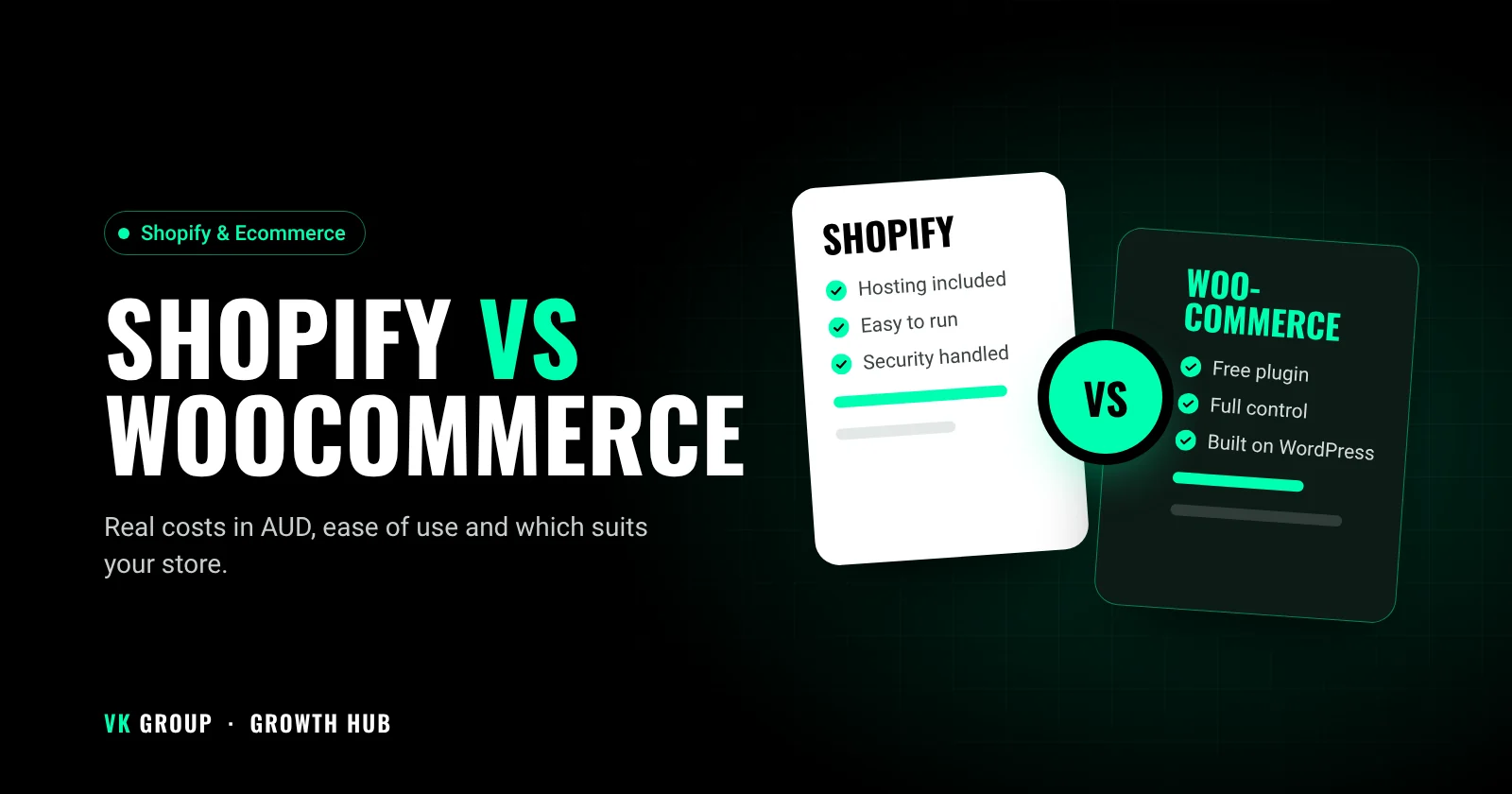
Choosing between Shopify vs WooCommerce is one of the first big decisions when you start an online store, and it’s an expensive one to change later. Both platforms run thousands of successful Australian stores. The right choice depends on how you want to run your business, not on which one is “better”.
We build on both, so here’s an honest comparison with current Australian pricing, plus when we’d recommend each.
The short answer
- Choose Shopify if you mainly sell products, want to manage the store yourself, and would rather not deal with hosting, security or updates.
- Choose WooCommerce if your website is content-heavy (lots of pages, articles or services), you already run WordPress, or you need very custom functionality and full control.
Shopify vs WooCommerce at a glance
| Shopify | WooCommerce | |
|---|---|---|
| What it is | An all-in-one hosted ecommerce platform | A free ecommerce plugin for WordPress |
| Platform cost | From $42/month (Basic, billed yearly) | Free to install |
| Hosting | Included | You pay for it separately |
| Security and updates | Handled by Shopify | Your responsibility (or your developer’s) |
| Ease of use | Very easy to run day to day | Easy once set up, more moving parts |
| Flexibility | High, within Shopify’s rules | Almost unlimited, you own the code |
| Add-ons | Shopify App Store (often monthly fees) | WordPress plugins (often yearly fees) |
| Best for | Product-focused stores that want to grow | Content-led sites and custom builds |
What does Shopify cost in Australia?
Shopify charges a monthly plan fee plus a card processing fee on each sale. These are Shopify’s current Australian prices (checked October 2026):
| Plan | Monthly price | Online card rate |
|---|---|---|
| Basic | $42 (billed yearly) or $56 | 1.7% + 30¢ |
| Grow | $114 (billed yearly) or $149 | 1.55% + 30¢ |
| Advanced | $431 (billed yearly) or $575 | 1.35% + 30¢ |
| Plus | From $3,700 | 1.15% + 30¢ |
If you use a payment provider other than Shopify Payments, Shopify adds its own transaction fee (2% on Basic, 1% on Grow, 0.6% on Advanced). For most Australian stores, Shopify Payments is the simplest and cheapest option. Most stores will also add a few paid apps, for things like reviews, subscriptions or email marketing.
What does WooCommerce cost?
WooCommerce itself is free, but running a store with it isn’t. You’ll pay for:
- Hosting: WooCommerce estimates US$25 to US$350 a month for most stores, depending on traffic. Good managed hosting matters, because a slow store loses sales.
- Extensions: around US$29 to US$299 a year each, for things like subscriptions, bookings or advanced shipping.
- Payments: WooPayments charges Australian stores 1.75% + 30¢ for domestic cards and 3.25% + 30¢ for international cards (plus GST if you’re not registered).
- Maintenance: WordPress, WooCommerce and every plugin need regular updates and security monitoring. Budget for a care plan or your own time.
Good to know
Compare the total cost of running each store for a year, not just the monthly plan. A free platform with paid hosting, extensions and maintenance can cost as much as Shopify, and a cheap Shopify plan with lots of paid apps can cost more than you expect.
Ease of use: running the store day to day
Shopify is built for store owners. Adding products, processing orders, printing labels and running discounts all happen in one tidy dashboard, and the mobile app is excellent. You won’t need a developer for everyday jobs.
WooCommerce runs inside WordPress, so it’s familiar if you already update your own site. It has more settings and more places for things to go wrong, especially when plugins update. Many owners are happy running it day to day, but most rely on a developer for upkeep.
Flexibility and growth
WooCommerce wins on raw flexibility: you own the code and can make it do almost anything. That’s great for unusual products, complex pricing or membership sites, but every custom feature is something to maintain.
Shopify is more structured, but its themes, apps and checkout are built to convert, and it scales from your first sale to millions in revenue without changing platforms. With custom theme development (Shopify’s Liquid templating), a Shopify store can still look and work exactly the way you want.
Security, speed and maintenance
This is the biggest practical difference. Shopify looks after hosting, security, speed and platform updates for you. With WooCommerce, keeping WordPress, the theme and every plugin updated and secure is up to you. It’s very doable, but it needs to be done consistently. Our guide What is a website care plan? explains what that looks like.
Which do we recommend?
For most businesses whose main goal is selling products online, we recommend Shopify. It’s easier to run, safer out of the box, and lets you focus on selling instead of maintaining software. Two recent examples: Cinch Skin lifted its conversion rate from 2% to over 8%, and Netley & Marsh tripled its conversion rate, both on custom Shopify builds.
We recommend WooCommerce when the store is part of a bigger, content-led WordPress website, or when the business needs functionality Shopify can’t easily handle.
Already on one and thinking of switching?
Moving from WooCommerce to Shopify (or the other way) is very doable. Products, customers and order history can usually be migrated, and old web addresses can be redirected so you keep your Google rankings. The key is planning the move properly rather than rushing it.
Not sure which platform suits your business? Get in touch and we’ll give you an honest recommendation, or read more about our Shopify development on the Gold Coast. For build costs, see how much a website costs in Australia.
Sources and further information
- Shopify pricing (Australia) (opens in a new tab) Shopify
- WooCommerce pricing (opens in a new tab) WooCommerce
- WooPayments fees by country (opens in a new tab) WooCommerce
Share this article
Want help with your website?
Tell us about your project and we'll come back with a clear plan and honest advice. No obligation.